Frozen Evaporator Coil on a Mitsubishi in Alhambra
Short and true: A frozen Mitsubishi coil in Alhambra (91801, 91803) is almost always restricted airflow - a clogged filter or dirty blower wheel - or low refrigerant from a flare-joint leak, often flagged as a P6, U7, or P8 code. Turn the unit off to thaw it, then call Alhambra Mitsubishi HVAC at (213) 755-2539 or book online before the compressor takes damage.
The summary
- Top cause: restricted airflow (dirty filter, fouled blower wheel, dirty coil)
- Second cause: low refrigerant from a leaking flare joint
- Related codes: P6 freezing protection, U7 low superheat, P8 abnormal pipe temp
- First move: turn it off and let it thaw fully before restarting
- Do not run a frozen unit - risk to the inverter compressor
- Airflow fix lane ~$150 - $400; leak repair ~$225 - $1,500 (2026 SoCal; verify)
- Service area: Alhambra 91801 and 91803, all seven neighborhoods
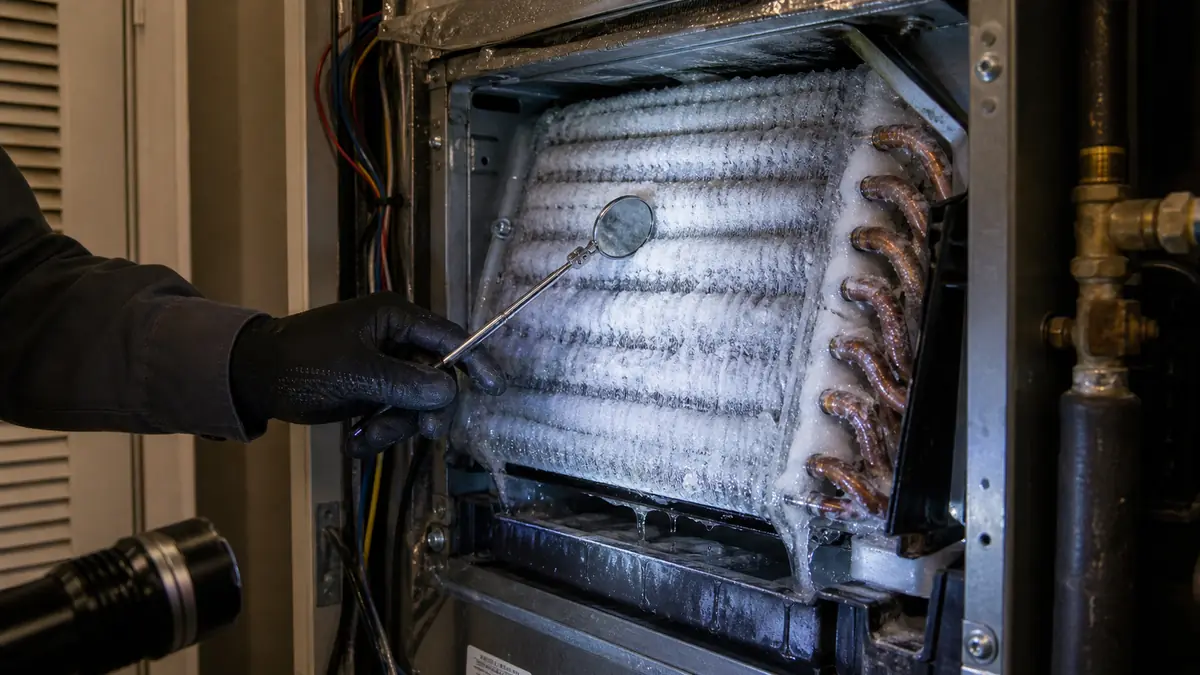
Why does a Mitsubishi coil freeze in the first place?
An evaporator coil only ices when the refrigerant inside it runs colder than 32 F while moisture from room air condenses on it. Two things cause that: too little warm air moving across the coil, or refrigerant pressure that is too low. In Alhambra, the airflow version is most common because the city's dusty, pollen-heavy air clogs ductless filters and blower wheels fast, and the head often runs nonstop through a Zone 9 heat run. Mitsubishi's control board usually senses the drop and throws a P6 freezing-protection fault, cutting cooling before the ice gets out of hand.
What should I check before I call?
| Symptom / code | Likely cause / first check | Cost lane |
|---|---|---|
| Ice on head, P6 fault, weak cool | Dirty filter or blower wheel - clean and re-test | ~$150 - $400 |
| Ice plus U7 low superheat | Low refrigerant from a flare leak - leak search + recharge | ~$225 - $1,500 |
| Ice plus P8 abnormal pipe | Refrigerant or sensor issue - meter pressures | ~$225 - $1,500 |
| Ice plus water dripping (P5) | Thaw water overwhelming a clogged drain | ~$150 - $450 |
You can safely clean or replace the filter and confirm the supply side is not blocked. Everything past that - refrigerant pressures, the LEV/EEV, the leak search - needs gauges and is where we come in.
How a tech actually diagnoses a frozen Mitsubishi coil
The order matters, because chasing refrigerant on what is really a dirty filter wastes your money. Here is the sequence we run. First, we confirm the unit is fully thawed and read the controller or kumo app for the stored code - a P6 freezing-protection fault points us toward airflow, a U7 low-superheat or P8 abnormal-pipe code points us toward refrigerant. Second, we check the cheap-and-likely airflow path: the filter, the barrel blower wheel behind it, and the indoor coil face, since a felt of Alhambra road dust on any of those is the usual culprit. Third, if airflow is clean, we put gauges on the service port and read superheat and subcooling; genuinely low refrigerant on a sealed ductless system means a leak, not a unit that "needs a top-up." Fourth, we leak-search the flare joints at the head and condenser with electronic detection or bubbles, because flares are the number-one leak point on mini-splits. Finally, if pressures and airflow both check out, we test the LEV/EEV electronic expansion valve and the TH2/TH5 pipe thermistors, since a stuck valve or a drifting sensor can starve the coil and ice it even with a full charge. Each step rules a cause in or out before we quote, so you are not paying for a guess.
Why is this worse in Alhambra's older homes?
A ductless head in a 1920s plaster-walled bungalow has no big filter rack and no duct buffer, so the single small filter loads up quickly and the coil is just behind it. Add the heat-island load of a dense urban core east of downtown LA, where the unit barely cycles off on a 92 F afternoon, and a slightly dirty coil tips into a freeze faster than it would in a cooler, breezier neighborhood. Twice-yearly maintenance is the cheapest prevention.
When does a freeze mean a real repair?
If the coil re-ices after a clean filter and a full thaw, the cause is refrigerant-side, not airflow, and that means a leak search and recharge or an LEV/EEV that is not metering correctly. Repeated freezes that you keep running through are also how compressors die, so do not keep restarting it. Book a Mitsubishi repair visit; if it quit entirely in a heat wave, our emergency service covers it, and weak airflow is the related symptom to read.
Common questions
Should I keep running my mini-split if the coil is iced?
No. Switch it off and let it fully thaw, which can take an hour or two. Running a frozen coil drives liquid refrigerant back toward the compressor and can damage it - a 1,200-to-3,500-dollar part. Turn it off, let it drip-dry, and find the airflow or refrigerant cause before restarting.
Why does a dirty filter freeze the coil?
Cold refrigerant in the indoor coil needs warm room air flowing across it to stay above freezing. A clogged filter or grimy blower wheel starves that airflow, the coil temperature drops below 32 F, and condensation freezes into a block of ice. Mitsubishi often catches this first as a P6 freezing-protection fault and cuts cooling to protect itself.
Can low refrigerant freeze the coil too?
Yes, and it is the more expensive cause. A leak at a flare joint lowers system pressure, which drops the coil's saturation temperature below freezing even with good airflow. You may see a U7 low-superheat or P8 abnormal-pipe code. This one needs a leak search, repair, and recharge - not just a filter swap.
Is ice on the outdoor unit in winter the same problem?
No. A light frost on the outdoor coil during heating is normal defrost behavior, and the unit clears it automatically. A solid ice block on the indoor head while cooling is the freeze fault this page covers. If the outdoor unit ices heavily and never defrosts, that is a separate sensor or reversing-valve issue worth a call.