Mitsubishi AC & Mini-Split Repair in Alhambra
Short and true: Alhambra Mitsubishi HVAC repairs Mitsubishi Electric AC and mini-splits across Alhambra and ZIPs 91801 and 91803, from Emery Park to Mayfair; call (213) 755-2539 or book online. We diagnose MSZ heads and MUZ condensers - capacitors, inverter boards, flare-joint leaks, and P/U fault codes - usually same week, with the 139-dollar diagnostic credited toward the repair.
The summary
- What we fix: MSZ/MUZ single-zone, MXZ multi-zone, MFZ floor, ducted SEZ/SVZ/MVZ - cooling faults
- Common repairs: capacitor, contactor, inverter PCB, LEV/EEV, refrigerant leak, drain pump, thermistor
- Diagnostic about 139 to 200 dollars, usually credited toward the repair
- Repair lanes: ~$150 capacitor to $1,200 - $3,500 compressor (2026 SoCal; verify per quote)
- Service area: Alhambra 91801 and 91803, all seven neighborhoods
- Hours: Weekdays 7am-6pm, weekends 8am-2pm; same-week standard, faster in a heat run
- Independent shop; in-warranty Mitsubishi units referred to authorized service
Why has my Mitsubishi AC stopped cooling?
When an Alhambra mini-split quits on a 92 F afternoon, the cause is almost always electrical, refrigerant-side, or airflow. The outdoor MUZ unit needs a healthy run/start capacitor and contactor to start the inverter compressor; a leak at a flare joint bleeds off R-410A until the coil ices and cooling fades; or a clogged filter starves airflow and trips a P6 freezing-protection fault. We start by reading the green operation LED and the controller or kumo cloud code, then meter components rather than guess.
What do the Mitsubishi fault codes mean?
Mitsubishi groups faults by letter: P-codes point to indoor sensors and protection, E-codes to communication, U-codes to the outdoor unit and inverter, and F-codes to power and phase. The ones we see most on Alhambra cooling calls:
- P4 / P5 - drain sensor or drain-pump fault; water under the head, cooling trips off.
- P6 - freezing/overheating protection, usually a dirty filter or coil restricting airflow.
- U7 - low discharge superheat, a classic low-refrigerant signature.
- P8 - abnormal pipe temperature, often a refrigerant leak at a flare.
- U6 / UF / UP - compressor overcurrent or stall, an inverter or compressor concern.
- E6 / E7 - indoor-outdoor communication, frequently loose S1/S2/S3 wiring.
What does Mitsubishi AC repair cost in Alhambra?
The part drives the price far more than the trip. Here are the lanes we quote against; the diagnostic is usually credited if you proceed.
| Symptom | Likely cause / first check | Cost lane |
|---|---|---|
| Outdoor unit hums, no start (U6/UF) | Run/start capacitor or pitted contactor | ~$150 - $450 |
| Weak cool, iced coil, short-cycle (U7/P8) | Refrigerant leak at a flare joint + recharge | ~$225 - $1,500 |
| Water at the head, cooling trips (P4/P5) | Clogged drain or failed drain pump | ~$150 - $450 |
| Dead outdoor unit, board suspected | Inverter / control PCB replacement | ~$400 - $2,000 |
| Compressor failure on old MUZ | Inverter DC compressor (replace vs. retire) | ~$1,200 - $3,500 |
How does a Mitsubishi AC repair actually go?
Every Alhambra no-cool MSZ/MUZ visit walks the same fixed checklist, top to bottom, so the component you end up paying for is the one the evidence convicted - never a hopeful swap of whatever was easiest to reach. Here is that checklist, step by step:
- Read the code first. The indoor head's green operation LED blink pattern plus the controller or kumo cloud code sorts the problem into indoor-sensor (P), communication (E), or outdoor-inverter (U) territory before a panel comes off.
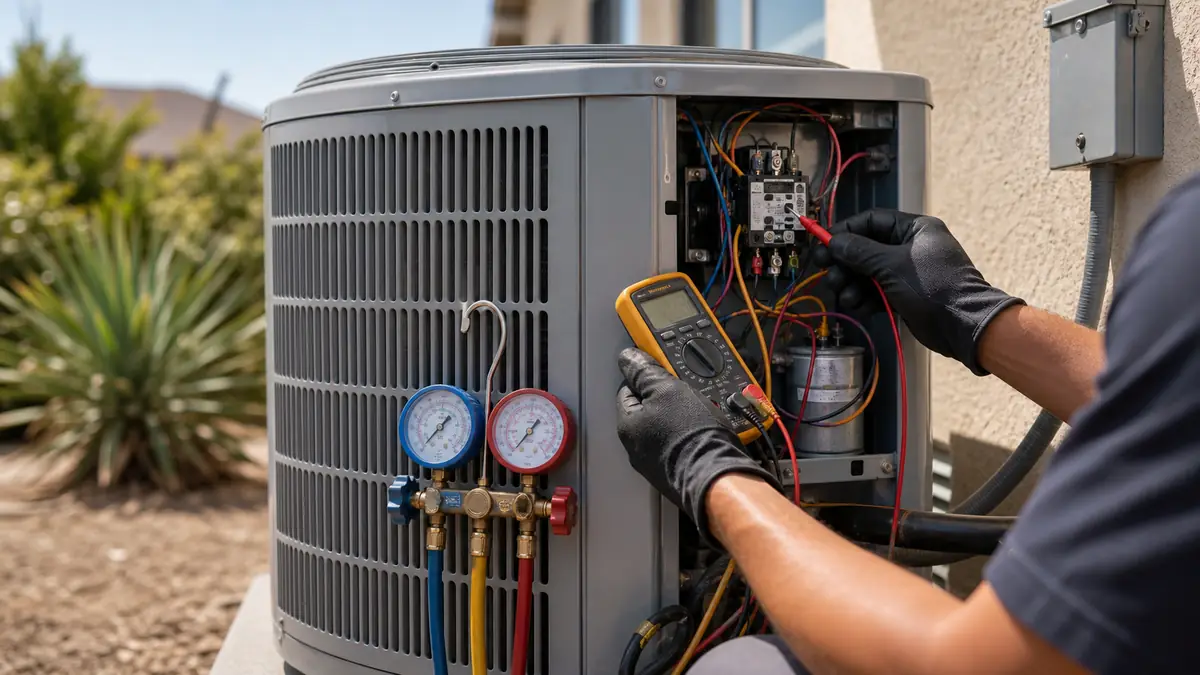
- Confirm the electrical. The run/start capacitor at the MUZ gets metered in microfarads and compared to its nameplate value, the contactor gets a look for pitted points, and an ammeter clamps the compressor leg to watch inrush on startup - that clears the cheap, high-frequency Alhambra failures before we go any deeper.
- Check the refrigerant side. With gauges on the service port we read superheat and subcool together, which tells a weeping flare joint (the U7 low-discharge-superheat and P8 abnormal-pipe-temp signature) apart from a hung LEV/EEV electronic expansion valve or nothing more than a dust-starved coil throwing P6.
- Inspect the indoor head. Filter, blower wheel, indoor coil, and the condensate pan, drain, and pump (P4/P5) get eyes on them, and the TH1/TH2/TH5 thermistors are ohmed out when P1/P2/P9 shows.
- Repair and verify. Once the part is in, we power the system back up, watch the fault code drop away, re-read superheat and the coil delta-T to confirm the numbers landed, and let it cool an Alhambra room through a complete cycle before we hand it back.
Which Mitsubishi families do you repair?
The whole M-Series and P-Series residential lineup, and the failure pattern shifts by family. Knowing which line you own tells us which parts are likely and how the price falls.
- MSZ-WR / MSZ-HM heads on MUZ-WR / MUZ-HM condensers - value and mid-tier single-zone (around 18 to 20 SEER2). Simpler boards, so capacitor, drain, and thermistor work dominate; the cheapest family to keep running.
- MSZ-GL / MSZ-GS heads - common budget and multi-zone heads. Same straightforward repairs, often as one zone on a shared condenser.
- MSZ-FS deluxe (MSZ-FS09NA / FS12NA / FS18NA) - the 3D i-see occupancy sensor and richer control board add one more thing that can drift or fail, alongside the usual drain and capacitor faults.
- MSZ-FX with MUZ-FX..NLHZ (H2i plus) - newest high-efficiency line, up to roughly 35 SEER2 in small sizes. Premium inverter electronics, so an out-of-warranty PCB sits at the high end of the lane.
- MXZ / MXZ-SM SMART MULTI multi-zone - one condenser, several heads; a shared-board or compressor fault takes every zone down at once.
- SEZ / SVZ / MVZ ducted and P-Series PUZ/PEAD/PVA - air-handler ECM blowers and slim-duct units on larger homes; newer single-zone ducted P-Series runs R-454B refrigerant, which we charge accordingly.
What drives the price of a repair in Alhambra?
Three things set the number: the part itself, whether the system is still under warranty, and access. The diagnostic (about 139 to 200 dollars) is usually credited if you proceed, so the repair total is mostly the part plus the labor to reach it.
- The part tier. A run capacitor is a 10-to-45-dollar component - you are paying for the trip and the meter work, so it lands near 150 to 450 dollars installed. A Mitsubishi inverter PCB part alone can run 120 to 800-plus dollars, pushing a board job to 400 to 2,000, and an inverter DC compressor to 1,200 to 3,500.
- Warranty status. Inside Mitsubishi's parts-and-labor coverage, a compressor or board can cost you nothing through authorized service - which is exactly why we route in-warranty units there first instead of charging you.
- Access in a 1920s home. A wall head over plaster on a tight Emery Park lot, or a condenser crammed into a narrow side yard, adds labor a suburban tract never does. Long line sets and second-story heads cost more to reach.
- Refrigerant. R-410A runs roughly 50 to 80 dollars per pound installed, so a leak that bled the system dry costs more to recharge than a small top-off after a flare repair.
Which parts fail most on Alhambra mini-splits?
Under Zone 9 heat, where 40 to 60 days a year climb over 90 F, the capacitor is the part that fails most - it strains hardest on the hottest days. After that we replace contactors, condensate pumps fouled by dust and pollen, thermistors (TH1 intake, TH2 liquid pipe, TH5 coil) that drift and confuse the board, and the LEV/EEV electronic expansion valve when it sticks. Inverter PCBs and compressors are the expensive, less-frequent failures, and the ones where age matters most. If yours is an MSZ-FS, the 3D i-see occupancy sensor is its own occasional fault.
When should I call instead of waiting?
Shut the system off and call if you see water tracking down a plaster wall, smell anything hot or electrical from the MUZ unit, or watch the head ice over - running it through a freeze or a leak only widens the damage. On a heat-wave no-cool, our emergency AC repair covers evenings and weekends. For airflow and noise specifics, see weak airflow from vents and strange noises, or the frozen coil walkthrough. If the repair math tips toward a new system, our AC installation page covers Manual J sizing and the install process.
Common questions
My MSZ head runs but blows room-temperature air. What is wrong?
Usually one of three things: the outdoor MUZ unit is not running (dead capacitor or contactor), the system is low on refrigerant from a leaking flare joint, or the LEV/EEV is stuck. We meter the capacitor, check the flare connections, and read any U7 or P8 code to tell which before quoting.
Is it worth repairing a 12-year-old Mitsubishi mini-split?
Depends on the part. A capacitor or drain pump on a 12-year-old MSZ is a clear fix. An out-of-warranty inverter compressor or control board at 1,200 to 3,500 dollars on a unit that old often pushes you toward replacement under the half-the-cost rule. We lay out both numbers.
Do you repair the outdoor condenser or just the indoor head?
Both - they are one system. We diagnose the MUZ or MXZ outdoor unit (compressor, inverter PCB, DC fan motor, capacitor) and the indoor MSZ head (thermistors, board, drain, blower wheel). Mitsubishi faults often live outdoors even when the symptom shows up at the wall head.
Can a dirty filter really stop my unit from cooling?
On a ductless head, yes. A clogged filter or fouled indoor coil starves airflow, drops the coil below freezing, and trips a P6 freezing-protection fault, so the unit cuts cooling to protect itself. We pull the filter and inspect the blower wheel first because that fix is cheap.
How long does a typical Mitsubishi AC repair take?
Most common fixes are one visit. A capacitor, contactor, drain pump, or thermistor is usually an hour or two on site once we confirm the fault. A flare-joint leak repair with evacuation and recharge runs longer, and an inverter PCB or compressor often means ordering the part and returning, since we do not stock every board on the van.
Do you find leaks instead of just topping off refrigerant?
We find and fix the leak. Adding R-410A to a leaking MSZ/MUZ system without repairing the flare joint or coil is a temporary patch that fails again and wastes refrigerant, which is also against EPA practice. We pressure-test, use a leak detector or nitrogen/bubble test at the flares, repair the joint, evacuate, then weigh in the correct charge.
Is a loud buzzing condenser dangerous?
Turn it off and call. A hard electrical buzz at the MUZ unit with no fan or compressor start usually means a failing capacitor or contactor drawing locked-rotor current, which stresses the compressor windings the longer it runs. Killing the breaker protects the expensive parts; we meter the capacitor and contactor and have you cooling again the same visit in most cases.