Mitsubishi AC & Ductless Installation in Alhambra
Short and true: Alhambra Mitsubishi HVAC installs Mitsubishi ductless AC and central inverter systems across Alhambra and ZIPs 91801 and 91803, from Emery Park to Orange Blossom Manor, sizing every job by Manual J for duct-free 1920s homes. A single-zone MSZ/MUZ runs $3,500 to $8,000; call (213) 755-2539 or book online for a written quote after a load calculation.
The summary
- Indoor options: MSZ wall heads, MFZ-KJ floor consoles, MLZ-KP ceiling cassettes, SEZ/SVZ/MVZ ducted
- Outdoor: MUZ single-zone, MXZ and MXZ-SM SMART MULTI multi-zone (2 to 8 heads)
- Single-zone install lane ~$3,500 - $8,000; multi-zone (3-4 zones) ~$9,000 - $20,000
- Ducted central inverter (SVZ/MVZ) ~$6,000 - $14,000 (2026 SoCal; verify per quote)
- Every system sized by Manual J load, never a square-footage rule of thumb
- Alhambra permit + Title-24 charge/airflow verification; HERS on duct work
- Service area: Alhambra 91801 and 91803, all seven neighborhoods; in-warranty units to authorized service
Why is ductless AC the right fit for Alhambra homes?
Alhambra's housing core is wall-to-wall 1920s and 1930s stock - Spanish Colonial revival, Tudor revival, Craftsman, storybook cottages, and the Colonial-revival tracts of Orange Blossom Manor - built with a single gas floor or wall furnace and no duct chase at all. Cutting central ductwork into a plaster-and-lath home means tearing open walls and surrendering closet space or ceiling height, so for most of this city "adding AC" means a ductless retrofit, not a duct repair.
Mitsubishi ductless answers that. An MSZ wall head or an MFZ-KJ floor console connects to an outdoor MUZ or MXZ condenser through a line set the diameter of a garden hose, needing only a tidy three-inch penetration through the exterior wall. We can cool one stubborn west-facing bedroom or zone an entire house without disturbing original plaster, and because Climate Zone 9 piles up 40 to 60 days a year above 90 F, the install is cooling-led: the heat-pump heating that comes with it is the bonus, not the headline.
Which Mitsubishi indoor unit goes in which room?
The head you choose is driven by the wall, the windows, and how the room is used - not by a single default. The lineup we install:
| Unit | Mount | Best Alhambra use |
|---|---|---|
| MSZ-FS09/12/18NA | Wall head, 3D i-see sensor | Main living room, comfort priority |
| MSZ-WR / MSZ-GL | Wall head, value tier | Bedrooms, secondary rooms |
| MSZ-FX06NL | Wall head, H2i plus, high SEER2 | Efficiency-first small zones |
| MFZ-KJ09/12/18NA | Floor console | All-window walls; old floor-furnace footprint |
| MLZ-KP12NA | 1-way ceiling cassette | Finished ceilings; nothing on the wall |
| SVZ-KP / MVZ-A ducted | Multi-position air handler | Homes with a usable duct chase or attic path |
How do you size a Mitsubishi system in Alhambra?
By a room-by-room Manual J load, because square footage alone hides the things that drive cooling demand in a pre-war home. A 1,300 sq ft Spanish Colonial behind bare plaster with single-pane steel-casement windows and a west exposure pulls a very different load than a re-insulated bungalow of the same footprint. We measure window area and orientation, wall and attic insulation, infiltration, and how each room is occupied, then settle on a head capacity per zone and pick the outdoor unit whose realistic simultaneous capacity matches - not the sum of every nameplate.
Right-sizing is the difference between a system that works and one that fights itself. Oversize a Mitsubishi inverter by even a half-ton and it satisfies the thermostat too fast, short-cycles, never runs long enough to wring humidity out of the air, and gives up the very efficiency you paid the inverter premium for. Undersize it and the head runs flat-out through the August peak and still loses ground in the afternoon. The Manual J is what keeps the system in its efficient modulating band, and it is also what we hand the permit office.
How many zones does an Alhambra house need?
It tracks the floor plan and how rooms are used, not the head count someone quoted over the phone. A compact 1,200 sq ft cottage often runs well on a two- or three-zone MXZ-SM - living room, primary bedroom, and a back bedroom. A larger Granada Park or Midwick home with a partitioned plan may want four to six heads so conditioned air is not expected to turn corners through closed doors and tight 1920s hallways. A single head only cools its own room plus a little spillover, which is why a whole-house job is a multi-zone MXZ system rather than one big head.
How does a Mitsubishi install actually go?
An install is a sequence with a commissioning step at the end that separates a system that lasts from one that leaks and ices in its second summer. On an Alhambra ductless job we work it in this order:
- Load and layout. The Manual J sets the head sizes and zone count; we walk the line-set routes, mark the three-inch penetrations, and pick a condenser spot off the street elevation with Mitsubishi's service clearances and quiet distance from bedroom windows.
- Mount and core-drill. Each MSZ head goes on a structurally sound interior wall with its mounting plate leveled; a diamond core bit takes the penetration cleanly through plaster and lath rather than cracking it, and the floor and trim are protected.
- Run and flare the line set. The refrigerant lines, control cable, and condensate route to the condenser; flares are cut and torqued to spec, since a sloppy flare is the number-one future leak that throws U7 and P8 codes years later.
- Electrical and condensate. A dedicated circuit and disconnect are set for the condenser, the S1/S2/S3 inter-unit cable lands at both ends, and the condensate is routed to drain or a pump so a P4/P5 fault never strands water on plaster.
- Evacuate and pressure-test. Before a drop of refrigerant moves, we put dry nitrogen on the line set to confirm the joints hold, then pull the circuit into a deep vacuum under 500 microns and watch it sit there, proving the lines are both leak-tight and bone-dry - the corner a hurried crew quietly cuts.
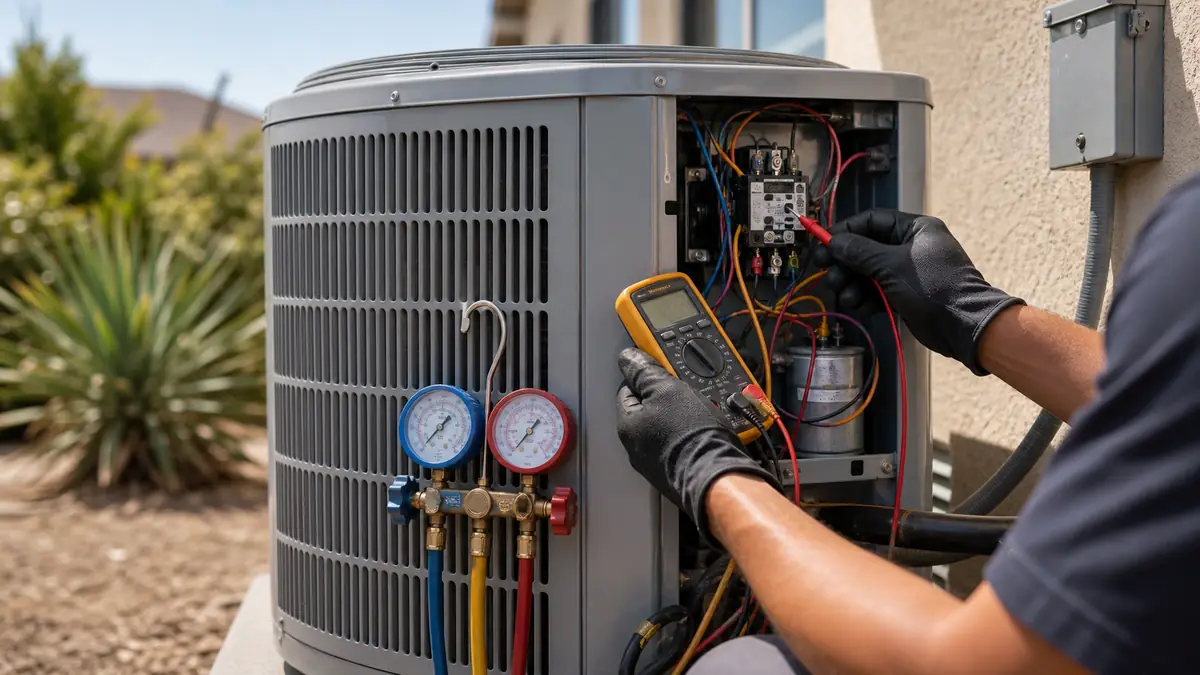
- Charge, commission, verify. Charge goes in by line-set length, then we fire the system, take superheat, subcool, and the coil delta-T on every zone, watch for a clean fault log, configure the kumo cloud or MHK2 control, and close out the Title-24 charge and airflow verification an Alhambra permit requires.
What does an AC install cost in Alhambra, and why?
The number is driven by zone count, equipment tier, and line-set runs far more than by the size of the house. These are typical 2026 Southern California lanes, confirmed in writing after the load calculation:
| System | What it covers | Cost lane |
|---|---|---|
| Single-zone ductless | One MSZ/MUZ head, line set, condensate, permit | ~$3,500 - $8,000 |
| Two-zone MXZ-SM | Two heads on one condenser | ~$7,000 - $13,000 |
| Multi-zone (3-4 zones) | MXZ-SM with three to four heads | ~$9,000 - $20,000 |
| Ducted central inverter | SVZ/MVZ air handler, existing duct path | ~$6,000 - $14,000 |
| Hyper-Heat conversion (ducted) | All-electric, drops the gas furnace | ~$6,000 - $16,000 |
Where the money goes
- Equipment tier. A value MSZ-WR head is a fraction of a deluxe MSZ-FS with its 3D i-see sensor or the high-SEER2 MSZ-FX; the head and matching condenser set the floor of the price.
- Zone count. Each added zone is another head, another line set, another penetration, and more commissioning - which is why a four-zone job is not four times a one-zone job but climbs steeply with each head.
- Line-set length and access. A condenser tucked into a narrow Emery Park side yard, a second-story head, or a long run to clear a historic facade all add labor and material a ground-floor short run does not.
- Electrical. If the panel has no spare capacity, a new circuit or a subpanel adds cost - common in homes still on their original 1920s service.
- Permit and verification. The Alhambra mechanical permit and the Title-24 charge, airflow, and HERS verification are a real line item we never bury or skip.
What permits and Title-24 rules apply in Alhambra?
A new or replacement split system in Title-24 Climate Zone 9 is a permitted mechanical alteration. The City of Alhambra issues the mechanical permit, and the 2022 Energy Code that governs 2026 work requires refrigerant-charge verification and airflow verification on the new system; any time we add, replace, or substantially alter ductwork, that triggers HERS duct-leakage field verification through an independent third-party rater. We pull the permit, schedule the rater, document the readings at commissioning, and hand you the signed certificate of compliance. Skipping it leaves an unpermitted system that surfaces at resale and can void a warranty claim, so it is built into the quote rather than offered as an upsell.
Are there rebates for a heat-pump AC install?
Maybe, but confirm the program is still funded before you count on a dollar figure. Heat-pump HVAC incentives have come through LADWP, Southern California Edison, SoCalGas, and the statewide TECH Clean California program, but several ran in limited funding rounds and TECH single-family funding was reported fully reserved statewide by early 2026. The federal 25C tax credit lapsed on December 31, 2025, so no federal HVAC credit applies to a 2026 install. We will run whatever paperwork a live program requires, but we verify it is open and funded on the program's own page first, rather than promise a number that has already dried up. The buying guide covers SEER2 and HSPF2 selection where a rebate hinges on efficiency tiers.
What about replacing an old system versus a fresh install?
If you already have an aging Mitsubishi system and are weighing a swap, the install side is the same craft, but the decision is different - a board or compressor on a 12-year-old MUZ can tip the math toward replacement under the half-the-cost rule. We lay the repair number next to a right-sized new system so the choice is yours on real figures, not a sales push. Start with the repair-or-replace guide, and if the verdict is a fix rather than a replacement, the AC repair page walks the diagnostics. For whole-home zoning, see multi-zone systems; to drop the gas furnace entirely, Hyper-Heat heat pumps.
Common questions
Can you put central air in an Alhambra house that only ever had a floor furnace?
Yes, and ductless is usually how. A single gas floor furnace and no duct chase is the standard pre-war Alhambra setup, so we cool it with Mitsubishi MSZ wall heads or an MFZ-KJ floor console fed by an outdoor MUZ or MXZ condenser, running a slim line set down an exterior wall instead of carving ducts into plaster. No attic ductwork, no lost closet space.
How do you size a Mitsubishi system - is it just square footage?
No. We run a Manual J load room by room, not a square-footage rule of thumb, because a west-facing 1920s parlor with single-pane windows and bare plaster pulls far more cooling load than a shaded north bedroom of the same size. Oversizing by even a half-ton makes the inverter short-cycle, leaving the air clammy; we size to the real load so it runs long and dehumidifies.
What does a Mitsubishi ductless install cost in Alhambra?
A single-zone MSZ head on a MUZ condenser typically installs for $3,500 to $8,000 depending on capacity and line-set length. A three- to four-zone MXZ-SM system lands around $9,000 to $20,000 at the SoCal high end, and a ducted SVZ/MVZ central inverter runs $6,000 to $14,000. We quote in writing only after the load calculation, never off a phone guess.
Do I need a permit and HERS testing for a new system in Alhambra?
Yes. A new or replacement split system in Climate Zone 9 triggers a City of Alhambra mechanical permit and Title-24 refrigerant-charge plus airflow verification, and any duct alteration adds HERS field verification through a third-party rater. We pull the permit, schedule the rater, and hand you the signed certificate - we never skip it to shave a day off the schedule.
How long does an install take, and how disruptive is it?
A single-zone MSZ head and MUZ condenser is usually one day. A three- to four-zone MXZ-SM retrofit in a partitioned 1920s home runs two to three days, longer if line sets are long, the electrical panel needs a circuit, or a historic-district facade calls for careful condenser placement. We protect floors and plaster, and the only real noise is the core-drilling for each three-inch wall penetration.
Can I add cooling now and keep my gas furnace for heat?
Yes. If you only want air conditioning, we install Mitsubishi ductless heads for cooling and leave the existing gas furnace in place for heat - a common first step in Alhambra. Many owners convert to an all-electric Hyper-Heat system later. Either way we size the cooling to the actual load so the new system does not short-cycle against the old furnace.
Will a mini-split look bad on a Spanish Colonial or Craftsman?
Not if it is placed with care. An MSZ head sits high and trim above the plaster, and the single compact outdoor unit goes off the primary street elevation in a side yard or rear setback. We run the line set in a paintable, color-matched cover rather than leaving it raw, so a 1920s storybook or Spanish-revival facade stays clean - a big part of why historic-conscious Alhambra owners call us.