Repair or Replace Your Mitsubishi AC in Alhambra
Short and true: In Alhambra (91801, 91803), repair a Mitsubishi unit when the fix stays well under half a new system's cost and the unit is under 10 to 12 years old, but tilt toward replacing once an out-of-warranty board or compressor turns up on an aging MUZ; Alhambra Mitsubishi HVAC lays both numbers side by side, so call (213) 755-2539 or book online.
The summary
- First yardstick: repair when the cost stays under ~50% of replacement AND the unit is under 10-12 years
- Second yardstick: once age x repair cost clears ~$5,000, tilt toward replace
- Check warranty first - a covered compressor or board can be labor-only
- Cheap, clear repairs: capacitor, contactor, drain pump, thermistor
- Expensive, age-sensitive repairs: inverter PCB, DC compressor
- Replacement weighs operating cost too, not just the repair quote
- The federal 25C credit lapsed 12/31/2025; confirm any rebate before you bank on it
- Install lanes: single-zone $3,500 - $8,000; multi-zone $9,000 - $20,000 (2026 SoCal; verify)
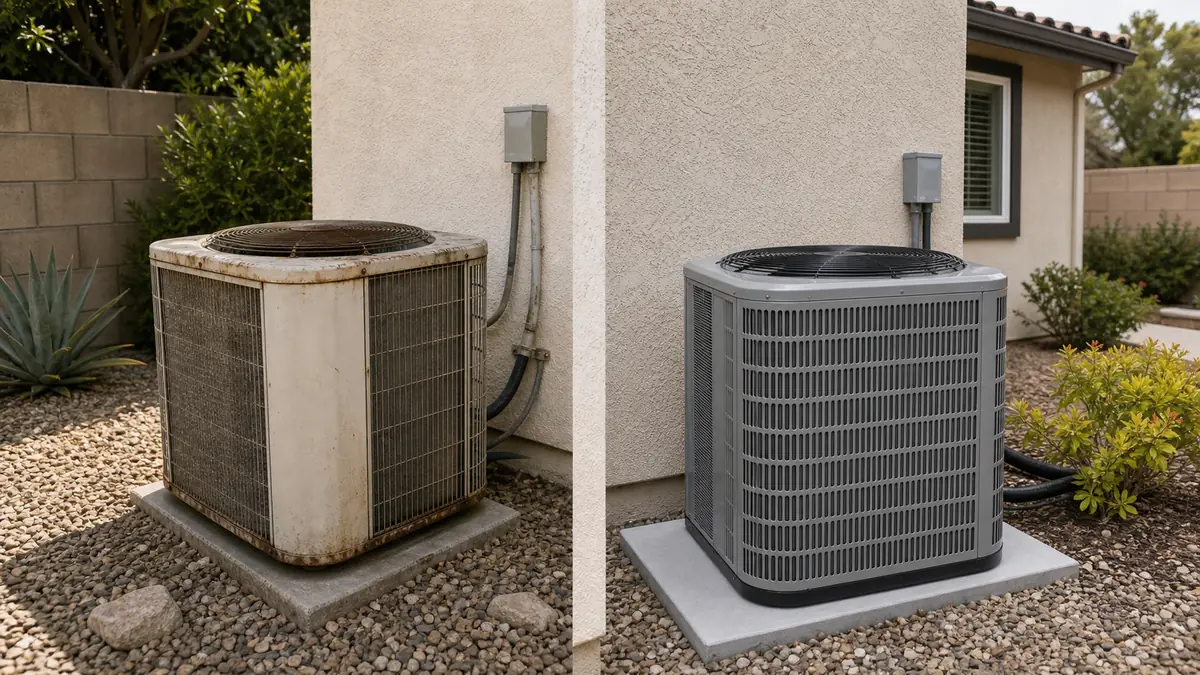
What are the actual rules of thumb?
Two yardsticks carry most of the weight, and we walk an Alhambra homeowner through both standing at the unit. The first looks at proportion: when the fix is quoting north of roughly half what a brand-new equivalent would set you back, and the equipment has a dozen-odd years on it already, replacing it tends to come out ahead. The second is a quick multiplication: take the unit's age in years times the repair cost in dollars, and any product above roughly 5,000 is your nudge toward replacement. Picture a 12-year-old unit needing a 450-dollar capacitor - that math hits 5,400 and reads "replace," yet judgment trumps the formula here, because a capacitor is a known, cheap fix that buys you years, so we repair it. These yardsticks surface the borderline cases; they are no substitute for a tech with eyes on the actual part.
Three worked examples from Alhambra homes
Those two yardsticks make a lot more sense once you watch them land on actual Alhambra dollars. Each case below is a situation we see on the city's ductless stock; the figures are approximate 2026 SoCal lanes you should still confirm against a written quote.
Example 1 - the clear repair. A 5-year-old MSZ-FS head in a Granada Park living room throws a P5 and drips; a worn drain pump plus a flush runs about 350 dollars. Comparable single-zone replacement is roughly 5,000 dollars, so the fix is about 7 percent of new - far under the 50 percent line. The age-times-cost check lands at 5 x 350 = 1,750, well below 5,000. Both yardsticks and common sense say repair, and the unit has a decade of life left. We fix it and move on.
Example 2 - the genuine coin-flip. An 11-year-old MUZ single-zone condenser in Emery Park needs an inverter control PCB at about 1,400 dollars. Replacement is near 6,000, so the repair is roughly 23 percent of new - under the line. But age-times-cost is 11 x 1,400 = 15,400, which screams replace, and an 11-year-old inverter board failing means the compressor and DC fan motor are aging on the same clock. Here we put the operating-cost difference on the table (an old 16-SEER-era unit versus a 20-plus SEER2 MSZ-FS over Alhambra's long cooling season) and let you decide. Often the board buys two or three years; sometimes the smarter money is the new system.
Example 3 - the clear replace. A 14-year-old MUZ in the Bean Tract needs a DC inverter compressor, out of warranty, at about 2,800 dollars. Replacement is roughly 6,000, so the repair is already 47 percent of new and creeping toward the line, while age-times-cost is 14 x 2,800 = 39,200 - off the chart. You would be sinking a four-figure sum into the single most expensive part of a system whose board, fan, and flares are all 14 years old. We recommend replacement and show what a current high-efficiency head would save you.
What is the failure chain on an aging Mitsubishi condenser?
The reason age tilts the math is that the expensive parts fail in a cluster, not in isolation. On a Mitsubishi MUZ outdoor unit, the components that age together are the DC inverter compressor, the inverter/power PCB (the board that throws U6 overcurrent or U5 heatsink faults), the outdoor DC fan motor (U8), and the flare connections that slowly weep refrigerant and surface as U7 low superheat or P8 abnormal pipe temperature. When one of those big-ticket items lets go at 12-plus years, the others are statistically close behind. That is the quiet cost the repair quote hides: a 1,400-dollar board today can be followed by a 2,800-dollar compressor next summer. By contrast, the cheap parts - capacitor, contactor, drain pump, thermistors - fail somewhat randomly across a unit's whole life and do not signal that the rest of the system is tired. That single distinction, age-correlated big parts versus random cheap parts, is what we are really reading when we make a call.
Which Mitsubishi repairs are clear fixes versus red flags?
The part matters more than the math. Cheap, high-value repairs almost always win regardless of age. Expensive inverter-electronics repairs on an old condenser are where replacement enters the conversation, because the rest of that unit is also aging toward its own failures.
| Repair | Cost lane | Usual call |
|---|---|---|
| Capacitor / contactor | ~$150 - $450 | Repair at almost any age |
| Drain pump / thermistor | ~$150 - $450 | Repair |
| Refrigerant leak + recharge | ~$225 - $1,500 | Repair if leak is fixable; watch repeat leaks |
| Inverter / control PCB | ~$400 - $2,000 | Repair if young; weigh if 10+ years |
| DC inverter compressor | ~$1,200 - $3,500 | Replace system if old and out of warranty |
How does Alhambra's climate change the math?
Running cost carries more weight here than it would in a mild coastal town. With Alhambra's Zone 9 summers working the system across 40 to 60 days a year over 90 F, a worn 14-SEER-era unit draws noticeably more power over a long cooling season than a current 20-plus SEER2 Mitsubishi. So when a four-figure repair is already looming on an old, inefficient condenser, the energy you would save with a new high-efficiency MSZ-FS or MSZ-FX pulls the replacement payback in closer. We set your likely operating cost beside the repair quote, so the comparison reflects more than just the part's sticker price.
What about warranty and rebates in the decision?
Check the warranty before anything else. A Mitsubishi unit still under its parts-and-labor coverage belongs at authorized service first, where a covered compressor or board can come down to labor only - and that alone can swing a "replace" back to "repair." On the replacement side, keep a cool head about rebate promises: the federal 25C tax credit lapsed December 31, 2025, leaving nothing federal for 2026, while California programs such as LADWP, SCE, and TECH Clean California shift their amounts and drain their funds, with TECH reported fully reserved statewide in early 2026. Confirm any incentive on the program's own page before you let it sway the decision.
Should I ever replace a Mitsubishi that still cools?
Occasionally, yes - and it is a real decision, not a sales pitch. If a 13- or 14-year-old single-zone unit still runs but cools weakly, costs a lot to operate at its old efficiency, and is now staring down a board or coil repair, replacing it can pay back over Alhambra's long Zone 9 cooling season rather than just postponing the bill. The case strengthens when an electrification rebate is live and your gas floor furnace is also near the end, because a single Hyper-Heat conversion can retire both the tired AC and the furnace at once. The case weakens fast if the unit is under 10 years, the repair is cheap, or the rebate you are counting on turns out to be reserved or expired - which several were by early 2026. We never lead with "replace it because it is old"; we lead with the repair, and only raise replacement when the operating-cost math actually favors it.
The bottom line before you spend
- Get the real fault code and failed part first - a P5 drain pump is a different decision than a U6 inverter board.
- Check warranty before anything: a covered compressor or board on a younger MUZ can be labor-only and flips the answer to repair.
- Run both yardsticks: under ~50 percent of new AND under 10-12 years leans repair; an age-times-cost product over ~5,000 leans replace.
- Weigh the failure chain: a big age-correlated part (compressor, inverter PCB, fan motor) on a 12-plus-year unit usually means more is coming.
- Factor operating cost over a 40-to-60-day-above-90-F summer, not just the repair sticker.
- Confirm any rebate on the program's own page; assume no federal 25C credit for 2026.
How do you help me decide without upselling?
We diagnose the actual fault, quote the real repair, and - only when the numbers warrant it - put a replacement option beside it with the operating-cost difference shown. If the fix is a cheap capacitor, we say repair and move on; we do not turn a 250-dollar visit into a 12,000-dollar quote. When replacement genuinely makes sense, the buying guide covers sizing and SEER2, and we assess what line set and electrical carry over to keep the cost down. To get the diagnosis that starts this whole decision, book a Mitsubishi repair visit or, in a heat-wave failure, emergency service. Keeping up maintenance is what pushes that replace date further out.
Common questions
What is the simple rule for repair versus replace?
Two yardsticks ride along on every Alhambra call. First: once a repair quote tops roughly half of what a like-for-like replacement would cost and the unit is already past the 10-to-12-year mark, replacement is the smarter lean. Second: multiply the unit's age by the repair cost, and when that figure clears roughly 5,000 dollars, replacing usually pulls ahead. Neither is the final word, but together they flag most of the close calls.
My Mitsubishi is only 6 years old but needs a compressor. Replace it?
Probably repair, and check the warranty first. A 6-year-old unit may still have compressor coverage, which makes the repair labor-only and cheap. Out of warranty, a compressor on a young, otherwise-healthy MUZ is usually still worth fixing because the rest of the system has years left.
Does it ever make sense to replace a unit that still works?
Sometimes. If a 14-year-old MSZ runs but cools poorly, costs a fortune to operate at its old SEER2, and you are about to put real money into a board or coil, replacing it with a high-efficiency MSZ-FS can pay back over Alhambra's long cooling season. We show you the operating-cost math, not just the repair quote.
If I replace, do I have to redo everything?
Not always. On a ductless system we can sometimes reuse a sound line set and electrical if they meet the new unit's spec, which trims the cost. A full multi-zone redesign is more involved. We assess what carries over before quoting a replacement so you are not paying to redo good infrastructure.